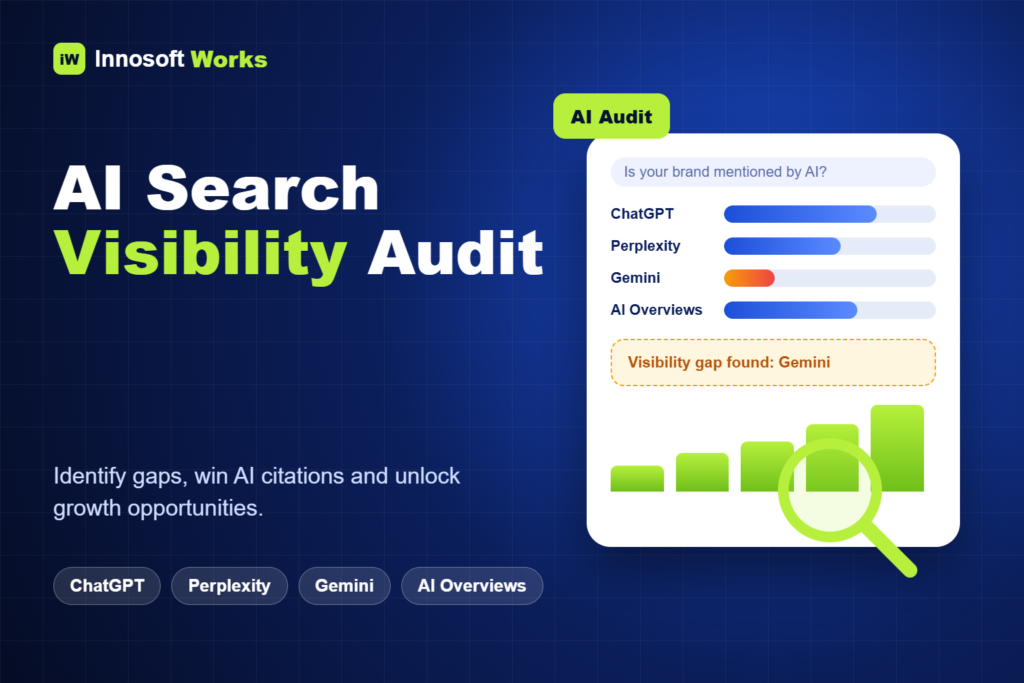
AI Search Visibility Audit: How to Identify Gaps and Growth Opportunities
An AI Search Visibility Audit evaluates how effectively your brand appears across AI-powered platforms such as ChatGPT, Perplexity, Google AI Overviews, and Gemini. It examines whether these platforms recognise your business, mention your brand, cite your website, and present accurate information about your services. By identifying visibility gaps, missing citations, and competitor advantages, businesses can discover opportunities to strengthen their presence in AI-generated answers and reach more potential customers.
At Innosoft Works, we help businesses understand and improve their visibility across emerging AI search platforms through tailored SEO solutions and a Generative Engine Optimization (GEO) Audit. Our approach focuses on strengthening brand authority, improving content relevance, and building a reliable digital presence that helps businesses remain discoverable as search behaviour evolves.
What Is an AI Search Visibility Audit?
What is a Generative Search Audit? It is an assessment that goes beyond checking whether a business appears in AI-generated responses. It examines the factors influencing how answer engines interpret, evaluate, and use a brand’s online information. This includes assessing entity clarity, content authority, source credibility, and the relevance of information available across the web. These insights help businesses understand what may influence their representation in AI-powered search experiences.
The audit also provides a structured way to evaluate how effectively existing SEO and Generative Engine Optimisation (GEO) efforts support AI discoverability. By examining content quality, technical foundations, and external brand references, businesses can identify weaknesses that limit their search presence. These findings provide a clearer direction for prioritising improvements and developing an effective LLM optimisation strategy.
How AI Search Platforms Discover Your Brand
AI-powered search platforms gather and process online information to answer user queries. However, each platform has its own approach to presenting information, selecting relevant sources, and connecting users with businesses. Understanding these differences helps companies evaluate where and how their brand may appear across AI-driven search experiences.
Google AI Overviews and AI Mode
Businesses exploring how to rank in Google AI Overviews should focus on providing helpful, reliable, and relevant information that addresses user queries. Google AI Overviews and AI Mode generate responses within Google Search by combining information from relevant web pages and displaying links to sources that provide additional context. This creates another opportunity for businesses to gain visibility beyond standard organic search results.
ChatGPT Search
A ChatGPT Search Optimization Audit examines how effectively a business’s online information supports its appearance in relevant search responses. ChatGPT Search combines conversational answers with information gathered from the web and can provide source links for users to explore further. Businesses may appear when their information is relevant to a user’s question, whether they are researching a service, comparing options, or looking for a specific solution.
Perplexity AI
Optimizing for Perplexity AI involves creating useful, well-supported content that addresses specific user questions. The platform focuses on answering questions through conversational search, with citations that connect responses to their original sources. Users can follow these references to verify information and explore topics in greater depth, making source credibility an important consideration for businesses.
Google Gemini
Google Gemini is Google’s AI assistant, designed to help users explore information, generate responses, and complete different tasks. Depending on the experience and query, it can draw on information from Google’s services and other relevant sources. For businesses, understanding how their brand is represented in Gemini provides another perspective on their visibility across AI-powered platforms.
6 Areas to Audit Your AI Visibility
A meaningful AI search visibility audit requires more than checking whether your business appears in a few generated answers. It involves examining the Generative AI search ranking factors that may influence how platforms recognise your brand, assess available information, and select sources for their responses. Reviewing these six areas helps businesses uncover weaknesses and identify where targeted improvements can make a difference.
Brand Recognition and Entity Accuracy
Check whether AI platforms correctly understand your business, including its name, industry, core services, products, and operating locations. Inconsistent descriptions or outdated details across online sources can create confusion about what your company offers. Review how your brand is presented in AI responses and compare that information with your official website and business profiles.
Mentions vs. Website Citations
An AI response brand citation audit examines whether platforms mention your business and provide links to relevant website pages. A brand mention and a website citation represent two different visibility outcomes. A platform may refer to your business without linking to your website, meaning users can recognise your name but may not have a direct route to explore your services. Track both results across relevant queries to understand how your brand is being represented.
Content Quality and Answer Structure
Evaluate whether your website provides clear, relevant information that addresses the questions your audience is likely to ask. Review important service pages, guides, and supporting articles for useful explanations, logical headings, and direct answers. A well-organised content structure makes information easier for readers to navigate and gives search systems clearer context about each page.
Technical AI Readiness
A Generative AI SEO audit checklist should include a review of the technical foundations that allow search systems to access and interpret your website. Check indexability, crawl accessibility, page performance, internal linking, and relevant structured data. Accurate schema markup can clarify details about your organisation, services, and published content, while technical issues may prevent important pages from being discovered or processed properly.
Third-Party Brand Presence
Your website is only one part of your brand’s online footprint. Examine how your business is represented on review platforms, industry publications, relevant directories, news websites, and community discussions. Look for credible references that support your expertise and identify inconsistent descriptions or missing coverage that could affect how others understand your business.
Competitor Visibility and AI Share of Voice
Compare your brand’s presence with competitors across the same set of relevant search prompts. Record how often each business appears, whether its website receives citations, and which topics generate stronger visibility. This comparison can reveal areas where competitors have established a stronger presence and highlight subjects your content or wider digital strategy may not be addressing.
How to Identify AI Search Visibility Gaps
Identifying AI search visibility gaps involves examining patterns across different customer queries and AI-generated responses. Rather than relying on a single result, compare repeated searches to understand which topics receive attention, where your business is overlooked, and how these patterns differ across platforms.
Once these patterns become clear, investigate the factors behind them. A closer review of search intent, competing resources, and the depth of available information can help determine why certain opportunities are being missed.
Analyse Search Query Patterns
Group your test prompts by customer intent, such as informational research, service comparisons, and purchase-related questions. Examine which categories consistently produce limited visibility for your business. This helps pinpoint areas where your current digital strategy may not align with the questions potential customers are asking.
Examine the Sources Behind AI Responses
Review the pages and publications referenced in AI-generated answers. Identify the types of resources that appear frequently, the subjects they cover, and the information they provide. This can reveal whether industry guides, specialist publications, research, or other external resources are contributing to stronger search visibility.
Identify Platform-Specific Differences
Compare results from ChatGPT, Perplexity, Google AI Overviews, and Gemini using similar prompts. Your brand may receive attention on one platform but remain less visible on another. Identifying these differences helps establish whether an issue is widespread or limited to a particular AI search experience.
Investigate Missing Topic Coverage
Look beyond individual website pages to identify subjects that receive attention in AI responses but are not adequately covered by your existing resources. These may include customer concerns, emerging industry topics, product comparisons, or detailed service questions. Such findings can help uncover relevant areas for future content development.
Prioritise Gaps by Business Value
Not every visibility gap deserves the same level of attention. Prioritise opportunities according to customer relevance, commercial intent, competitive importance, and the effort required to address them. This creates a practical improvement roadmap that connects AI search findings with measurable business objectives.
Best Tools to Measure AI Search Visibility
Businesses can use manual tracking and an AI search engine visibility tool to evaluate their performance across AI-powered search experiences. The right solution depends on reporting requirements, monitoring needs, and the scale of the business. Useful options include:
- Manual AI Visibility Scorecards: Use a consistent process for tracking brand mentions in LLMs by testing selected customer prompts and recording brand references, source citations, and competitor appearances.
- Semrush AI Visibility Toolkit: Explore AI brand visibility, competitor activity, and the sources associated with AI-generated responses.
- Ahrefs Brand Radar: Monitor brand mentions and citations across AI search experiences to understand how your business is represented online.
- LLM Visibility Tracking Tools: Compare different solutions based on supported platforms, prompt monitoring, reporting features, and historical performance data.
Turn Audit Findings into Growth Opportunities
Audit results provide a foundation for making informed improvements to your AI search strategy. Businesses can use these findings to select the most valuable actions, allocate resources effectively, and create a focused plan for improving their digital performance.
Strengthen Brand Authority
To improve brand presence in AI answers, publish original insights, share professional expertise, and maintain an active presence in relevant industry communities. Participate in meaningful discussions and contribute useful information that establishes your business as a knowledgeable source within its field.
Improve Content for AI Answers
Structure important pages around specific customer questions and search intent. Use informative headings, concise explanations, relevant examples, and useful FAQs to make complex subjects easier to understand. Ensure each page provides genuine value rather than simply repeating information available elsewhere.
Build Authority Through Digital PR
Develop newsworthy stories, industry research, expert commentary, and useful resources that attract editorial interest. Build relationships with relevant journalists and publishers to create opportunities for meaningful media coverage and industry recognition.
Enhance Technical SEO and Structured Data
Address technical barriers by reviewing website indexability, XML sitemaps, internal links, and page performance. Apply appropriate Organisation, Service, and other relevant schema markup to help search systems interpret specific website information more accurately.
Expand Your Topic Coverage
Create dedicated resources for important subjects that are missing from your content strategy. Consider emerging industry developments, specialised service topics, and questions that require more detailed explanations. Connect related articles through a logical internal linking structure to develop comprehensive coverage of relevant themes.
Create an Actionable AI Search Growth Plan
For larger organisations, an AI Search Audit for Enterprise Marketing can help align visibility improvements with wider business objectives. Start by prioritising actions according to their potential impact, whether they involve refining key content, strengthening brand authority, or addressing technical issues. Set realistic timelines and assign responsibilities to ensure each action has a clear purpose.
An AI search visibility report for CMOs can summarise progress through brand mentions, website citations, competitor visibility, and relevant website performance. Use these findings to review results, refine priorities, and guide future decisions as AI search experiences evolve. A consistent approach helps businesses adapt to changing search behaviour and build stronger visibility across AI-powered platforms.
FAQs
1. Does a High Google Ranking Guarantee Visibility in AI Search?
No. Strong organic rankings can support discoverability, but AI platforms may consider additional factors when selecting information for generated answers. Relevant content, source credibility, brand recognition, and query context can also influence whether a business appears.
2. Why Do Different AI Platforms Give Different Answers About the Same Business?
Each platform uses its own systems, available information, and methods to generate responses. As a result, one platform may highlight a business’s services while another may reference different sources or present alternative details.
3. How Many Search Queries Should an AI Visibility Audit Test?
A useful starting point is around 30–50 carefully selected queries covering informational, commercial, and service-related intent. The exact number can vary depending on the business, industry, and range of services being evaluated.
4. Can Local Businesses Appear in AI-Generated Recommendations?
Yes. A local AI search visibility audit can help businesses assess how they appear in location-based searches, service recommendations, and questions about nearby providers. Clear business information, relevant local content, and credible online references can support local discoverability.
5. How Long Does It Take to Improve AI Search Visibility?
There is no fixed timeframe for improving AI search visibility. Progress depends on the issues identified, the improvements implemented, industry competition, and how frequently platforms update or retrieve information. Regular monitoring helps businesses evaluate changes over time.
Make Your Brand More Visible in AI Search
An effective AI search visibility audit helps businesses understand how AI platforms recognise their brand, which sources influence their recommendations, and where competitors gain an advantage. By addressing these gaps through stronger content, credible online references, and a well-planned SEO and GEO strategy, businesses can improve their chances of appearing in relevant AI-generated answers. This approach supports future-proofing SEO for AI search while helping businesses maintain a stronger digital presence as search continues to evolve.
Looking for the best AI search optimization agency to support your digital growth? Explore tailored AI search solutions with Innosoft Works.
Leave a Reply