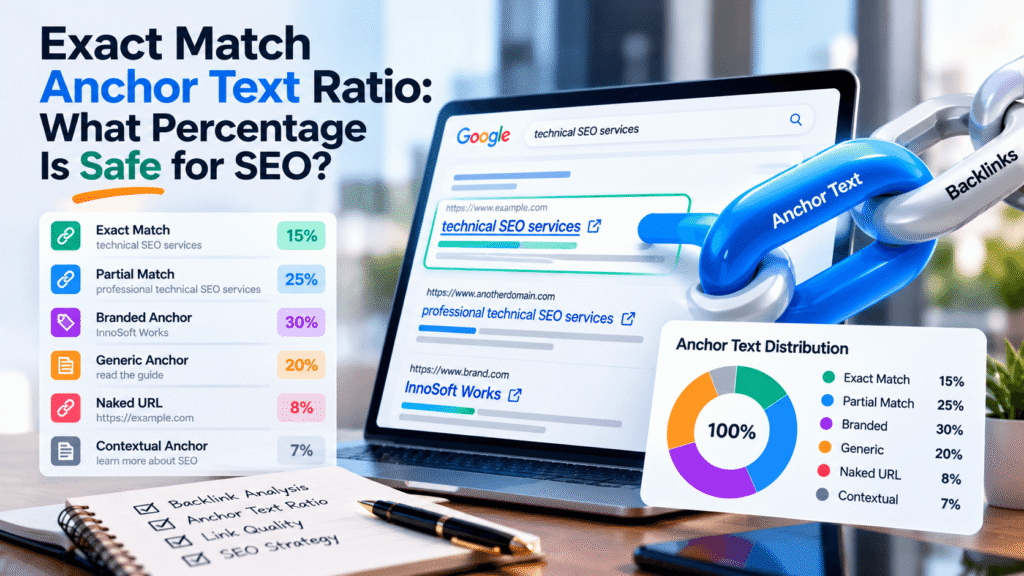
An exact match anchor text ratio measures the percentage of backlinks that use a target keyword as clickable text. There is no universally safe anchor text percentage in 2026. Instead of following an arbitrary number, websites should focus on relevant backlinks, natural anchor text patterns, and legitimate link-building practices.
At InnoSoft Works, we help businesses understand backlink quality, refine their anchor text distribution strategy, and build stronger SEO foundations. A well-managed backlink profile can also support broader search visibility and AI search citation optimization by helping search engines understand the relevance and context of your website.
What Is Exact Match Anchor Text?
Exact match anchor text is clickable link text that matches the target keyword of the page being linked to.
For example, if a page targets the keyword “technical SEO services,” a backlink using technical SEO services as its clickable text is an exact match.
Other anchor text types include:
- Partial Match: Includes the target keyword alongside other words, such as “professional technical SEO services.”
- Branded Anchor: Uses a brand name, such as “InnoSoft Works.”
- Generic Anchor: Uses general phrases such as “read the guide” or “visit the website.”
- Naked URL: Uses a web address, such as example.com.
- Contextual Anchor: Describes the linked page naturally within the surrounding sentence.
Each type can serve a purpose. The right choice depends on the context of the link and the page it points to.
What Is an Exact Match Anchor Text Ratio?
The exact match anchor text ratio is the percentage of backlinks in a selected dataset that use a specific target keyword as their anchor text.
For example, suppose a website has 100 backlinks in a report, and 15 use the exact keyword “technical SEO services.”
The calculation is:
Exact match anchor text ratio = (Exact match backlinks ÷ Total backlinks) × 100
In this example:
(15 ÷ 100) × 100 = 15%
This figure describes the selected backlink dataset. It does not establish whether the profile is natural, manipulative, or safe for SEO.
When calculating the ratio, define your dataset clearly. A report containing 100 referring pages may produce a different result from one containing 100 individual backlinks, because a single page can link to a website more than once.
What Is a Safe Anchor Text Percentage in 2026?
There is no official Google-recommended safe anchor text percentage in 2026. A ratio of 5%, 10%, 20%, or another figure should not automatically be considered safe or unsafe without examining the context. The more important questions are how the links were acquired, whether the linking pages are relevant, and whether the anchor text appears natural.
For example, consider two backlink profiles:
Profile A: A website receives relevant editorial links from industry publications. Some use descriptive keyword anchors, while others use the brand name or article title.
Profile B: A website obtains numerous links through paid guest posts, and many use the same keyword-rich anchor text to influence rankings.
Even if both profiles show the same exact match anchor text ratio, their link acquisition patterns are different. The percentage alone cannot explain the risk.
Google identifies links created primarily to manipulate search rankings as link spam. Its policies also address paid links that pass ranking credit and optimized anchor text used in manipulative link schemes.
How to Analyse Your Anchor Text Distribution
A clear anchor text distribution strategy helps you understand how other websites refer to your content and whether your link-building practices need attention. Rather than aiming for a fixed percentage, review the different anchor types and the context in which they appear.
1. Export Your Backlink Data
Use a backlink analysis tool to export referring pages, target URLs, and anchor text. Tools such as Ahrefs and Semrush can help organize this information.
Make sure you understand whether your report counts individual backlinks, referring pages, or referring domains. These metrics are not interchangeable.
2. Group Anchors by Type
Classify the anchors into categories such as:
- Exact match keywords
- Partial match keywords
- Brand names
- Generic phrases
- Naked URLs
- Other descriptive anchors
This makes it easier to identify repeated patterns without assuming that one category must meet a specific percentage.
3. Review the Linking Pages
Check whether the linking pages are relevant to your website and whether the links appear naturally within useful content.
For example, a link to a technical SEO guide from an article discussing website audits may make sense. The same keyword anchor repeated across unrelated websites and low-quality pages deserves closer inspection.
4. Investigate Unusual Patterns
Look for repeated keyword-rich anchors, links from unrelated websites, sudden increases in backlinks, and links associated with paid or automated schemes.
These patterns are reasons to investigate, not automatic proof of a penalty or a problem. Consider how the links were created and review any available evidence before taking action.
What Are the Risks of Over-Optimized Anchor Text?
Over-optimized anchor text can become a concern when it is part of a link-building strategy designed primarily to manipulate rankings.
Repetitive Keyword-Rich Links
When many backlinks use identical commercial keywords, particularly through coordinated link-building campaigns, the pattern may indicate attempts to influence search rankings.
Irrelevant Linking Websites
A backlink may provide little contextual value when it comes from a website or page unrelated to the linked content. Repeated links from unrelated sources can warrant further investigation.
Manipulative Paid Links
Buying links to pass ranking credit or distributing articles primarily to obtain keyword-rich backlinks can conflict with Google’s spam policies. Paid placements should be appropriately qualified using rel=”sponsored” or, where appropriate, rel=”nofollow”.
The key to over-optimization penalty prevention is to evaluate link acquisition practices rather than treating every exact match anchor as harmful.
Google September 2026 Spam Update and Anchor Text
Google’s September 2026 spam update began on September 24, and its rollout was completed on October 8, 2026. The update applied globally and to all languages.
The announcement confirms the rollout dates, but Google has not publicly identified specific anchor text ratios or individual backlink signals targeted by this update. Therefore, it would be inaccurate to assume that a particular exact match anchor text percentage caused ranking changes.
If your website experienced visibility changes around this period, review its organic search performance, backlink patterns, and overall compliance with Google’s spam policies. Compare performance before, during, and after the rollout rather than attributing every ranking fluctuation to anchor text.
How to Avoid Google Link Spam Penalty in 2026
Avoiding Google link spam issues requires attention to how backlinks are acquired and used. A natural backlink profile should develop through relevant content, genuine references, and legitimate editorial mentions.
Consider these practices:
- Avoid purchasing backlinks primarily to manipulate search rankings.
- Do not use automated tools to create large volumes of keyword-rich links.
- Avoid excessive link exchanges and coordinated linking schemes.
- Use descriptive anchor text that accurately represents the destination page.
- Qualify paid placements appropriately.
- Review suspicious backlink patterns before taking corrective action.
These steps help reduce the risk of manipulative link-building practices. However, no anchor text formula or SEO technique can guarantee protection from every search spam issue.
How to Build a Natural Anchor Text Profile
A natural backlink profile develops through relevant content, genuine editorial references, and appropriate link acquisition practices. It does not require an artificial distribution of anchor text types.
Use Descriptive, Relevant Anchor Text
Choose link text that accurately describes the destination page. Exact match anchors can be appropriate when they fit the sentence naturally, but there is no need to force a target keyword into every link.
Build Links Through Useful Content
Create resources that others have a genuine reason to reference, such as original research, detailed guides, useful tools, and practical industry insights.
Relevant editorial links can support discovery and provide context for users. Well-structured, informative content can also contribute to AI search citation optimization by making key information easier to understand and reference. However, backlinks or anchor text choices do not guarantee citations in AI-generated search results.
Monitor Patterns Instead of Chasing Percentages
Review anchor text data periodically and investigate unusual changes. Avoid changing anchors solely to reach an arbitrary ratio.
Google recommends writing anchor text that is descriptive, concise, and relevant to the linked page. Its guidance does not prescribe a universal exact match anchor text percentage.
Review Internal and External Links Separately
Internal links are controlled by your website, while external backlinks are created by other websites. Review each in its own context.
For internal links, use descriptive anchors that help visitors understand the destination. For external backlinks, assess relevance, acquisition methods, and the surrounding content.
Should You Change Your Exact Match Anchor Text Ratio?
Not necessarily. A high ratio alone does not prove that a website has violated Google’s guidelines, and a low ratio does not guarantee a healthy backlink profile.
Before changing your link strategy, ask:
- Were the links earned naturally or created through a deliberate link scheme?
- Are the linking pages relevant to the destination?
- Do repeated anchors come from a legitimate reason, such as citations of a specific service or resource?
- Is there evidence of paid, automated, or otherwise manipulative link building?
- Have you received a manual action or identified a specific backlink issue?
If the links were acquired through manipulative practices, address the underlying cause rather than simply trying to lower a percentage. If the links are legitimate and relevant, changing them only to meet an arbitrary target may be unnecessary.
When Do You Need Backlink Profile Recovery Services?
Backlink profile recovery services may be worth considering when a website has a documented history of manipulative link building, a manual action related to unnatural links, or a substantial number of suspicious backlinks that require investigation. A recovery process should begin with a detailed backlink audit.
This includes identifying potentially manipulative links, reviewing how they were acquired, documenting relevant evidence, and deciding whether corrective action is appropriate. Removing or disavowing backlinks without proper investigation can be unnecessary. The right response depends on the nature of the links and whether Google has identified a specific issue. A lower exact match anchor text ratio alone is not a recovery strategy.
FAQs
Can exact match anchor text improve rankings?
Descriptive anchor text helps users and search engines understand a linked page. However, repeatedly creating keyword-rich backlinks to manipulate rankings can violate Google’s link spam policies.
Should I remove all exact match backlinks?
No. Exact match anchors are not inherently harmful. Investigate suspicious links and consider their context before deciding whether action is necessary.
How often should I check anchor text distribution?
Review your backlink profile periodically and after significant link-building campaigns or unusual backlink changes. The appropriate frequency depends on your website and link acquisition activity.
Does Google recommend an ideal anchor text ratio?
No. Google provides guidance on relevant, descriptive anchor text and policies against manipulative link practices, but it does not publish a universal safe percentage for exact match backlinks.
Did the September 2026 spam update target exact match anchor text?
Google confirmed the September 2026 spam update, but its public announcement did not identify specific exact match anchor text ratios or backlink signals as targets. Avoid assuming that a particular anchor text percentage caused a ranking change.
Build a Healthier Backlink Profile Through Relevant Links
Exact match anchor text ratio can be a useful diagnostic metric, but it should not be treated as a standalone SEO target. Focus on relevant links, descriptive anchor text, legitimate link acquisition, and a backlink profile that makes sense for your website. By reviewing the context behind your backlinks instead of chasing a fixed percentage, you can make more informed link-building decisions and align your strategy with Google’s guidance.
Build a stronger backlink profile and improve your SEO strategy with expert guidance from InnoSoft Works.
Leave a Reply