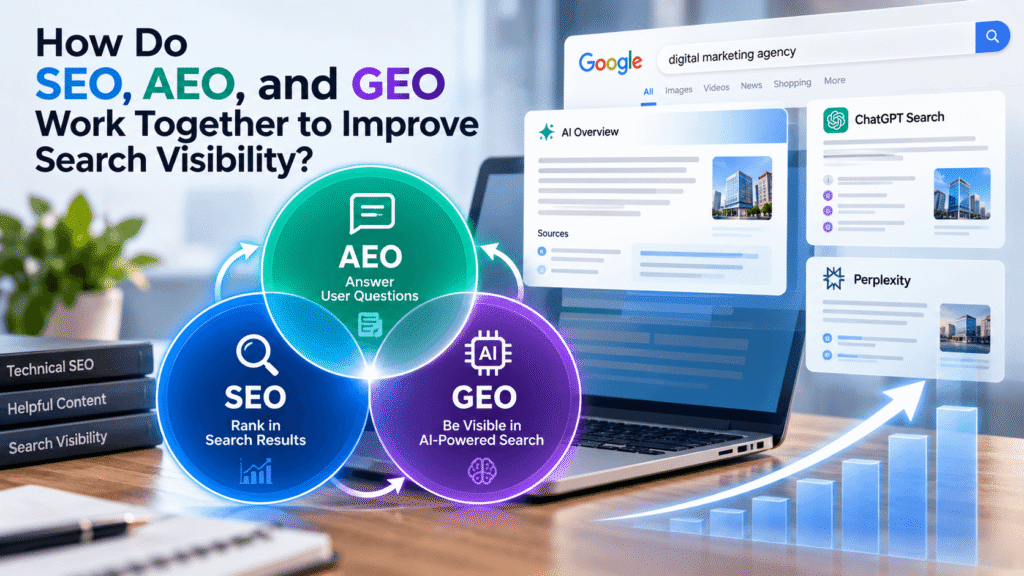
SEO, AEO, and GEO work together to improve search visibility by helping websites appear in traditional search results, answer users’ questions clearly, and provide useful information for AI-powered search experiences. Each approach has a different focus, but combining them helps businesses create content that is accessible, relevant, and easier to understand. A well-planned SEO AEO GEO strategy connects these approaches instead of treating them as separate activities.
Innosoft Works helps businesses strengthen their online visibility through technical SEO, answer-focused content, and Generative Engine Optimization. By aligning these approaches, businesses can create useful content that supports discoverability across traditional search engines and AI-powered platforms.
What Are SEO, AEO, and GEO?
SEO, AEO, and GEO share the goal of making useful information easier to discover, but each addresses a different part of the search experience.
What Is SEO?
Search Engine Optimization (SEO) helps websites improve their visibility in organic search results. It focuses on making pages accessible to search engines, matching content to relevant search intent, and providing a positive user experience.
Key SEO activities include:
- Technical SEO: Improving crawlability, indexability, site structure, and page performance.
- On-page SEO: Optimizing page titles, headings, internal links, and relevant keywords.
- Content optimization: Creating useful information that addresses the needs of the target audience.
- Off-page SEO: Earning relevant, trustworthy links and references.
- Performance tracking: Reviewing organic impressions, clicks, rankings, and conversions.
SEO provides an important foundation for AEO and GEO because accessible, relevant content is easier for search systems to discover and process. However, technical optimization alone does not guarantee rankings or inclusion in AI-generated responses.
What Is AEO?
Answer Engine Optimization (AEO) focuses on making content useful for answering specific questions. It supports answer-focused search experiences, including featured snippets and some voice-search responses.
Businesses offering Answer Engine Optimization services typically focus on clear answers, useful content structure, and relevant search intent.
Common AEO practices include:
- Answering relevant questions directly and accurately.
- Using descriptive headings that reflect users’ questions.
- Providing concise explanations with enough supporting context.
- Organizing information with clear paragraphs, lists, and tables where appropriate.
- Implementing relevant structured data when it accurately describes the page.
An AEO audit checklist can help assess whether a page answers its main question, uses descriptive headings, provides accurate information, and includes appropriate structured data. These practices improve clarity but do not guarantee featured snippets or voice-search placements.
What Is GEO?
Generative Engine Optimization (GEO) focuses on helping AI-powered search systems understand a business, its content, and the information it publishes. These systems may generate responses using information gathered from multiple sources.
GEO is relevant to generative search experiences such as Google AI Overviews and platforms including ChatGPT Search, Gemini, and Perplexity.
Relevant GEO practices include:
- Publishing accurate, specific, and helpful content.
- Explaining services, expertise, and business information consistently.
- Supporting important claims with reliable evidence.
- Building credibility through relevant third-party references and genuine mentions.
- Covering related topics to provide sufficient context.
LLM optimization techniques may include improving factual clarity, explaining related concepts, organizing information logically, and keeping business details consistent. These practices can help make information easier to interpret, but they cannot guarantee that an AI platform will mention or cite a website.
How Do SEO, AEO, and GEO Work Together?
SEO, AEO, and GEO work together when a website’s technical structure, content, and credibility support the same search visibility goals. SEO helps search engines access and understand pages, AEO makes answers easier to find and use, and GEO emphasizes the context and credibility that may help AI systems interpret and reference information.
1. SEO Creates the Foundation
SEO establishes the technical and content foundation for discoverability. A website needs accessible pages, logical navigation, relevant information, and content that matches what people are searching for.
For example, a digital marketing agency targeting businesses in Adelaide might create a page about its SEO services. The page should have a descriptive title, a clear structure, relevant service information, and useful internal links. Technical checks can help identify crawling, indexing, mobile usability, or performance issues that may affect access to the page.
This foundation also supports AEO and GEO. Clear, accessible content is easier to navigate and interpret than information hidden behind confusing navigation or presented inconsistently.
Businesses exploring how to rank in AI Overviews should start by ensuring their pages are accessible, useful, and relevant to their target queries. There is no guaranteed method for securing an AI Overview placement, and traditional indexing alone does not guarantee inclusion in an AI-generated response.
2. AEO Makes Content Easier to Use as an Answer
Once content is accessible and relevant, AEO helps present information in a format that directly addresses users’ questions.
The agency’s SEO services page could answer questions such as:
- What SEO services does the agency provide?
- How can local SEO help a business?
- What is included in a technical SEO audit?
- How can a business measure SEO performance?
Each question should receive an accurate, direct answer followed by enough detail to explain the topic properly. Descriptive headings and a logical page structure help users navigate the content and understand the relationship between different services.
This answer-focused structure addresses specific search intent rather than relying only on broad keywords. It can also support GEO by making the information easier to interpret.
For businesses developing a voice search marketing strategy, concise answers and conversational question formats can help address spoken queries. Schema markup for AEO can also provide structured information about eligible content when implemented correctly. However, structured data does not guarantee a particular search placement, and Google does not require special schema markup for inclusion in AI Overviews.
Local businesses can also maintain accurate business details and relevant location information as part of local SEO for AI voice assistants. These practices support clear, consistent information without guaranteeing that a voice assistant will select a particular business.
3. GEO Adds Context and Credibility
SEO and AEO help make an agency’s page accessible and understandable. GEO builds on this by focusing on clear context, accurate information, and credible business claims.
For example, an agency can strengthen its content by:
- Explaining expertise: Describe technical SEO processes, services, experience, and working methods clearly.
- Maintaining consistent information: Keep business details accurate across relevant online sources.
- Building credible references: Use citation building for AI search to earn relevant references from trustworthy sources rather than irrelevant links or manufactured mentions.
- Developing genuine brand mentions: Support brand mentions for AI visibility through relevant publications, useful content, and authentic business discussions.
- Reviewing AI platforms: Explore a Perplexity AI SEO strategy or SEO for Google Gemini as part of broader AI search optimization.
The priority is to publish accurate, accessible content that establishes clear context. Platform-specific optimization should be based on observed behaviour rather than unverified ranking formulas.
4. How the Three Approaches Reinforce One Another
SEO, AEO, and GEO are most useful when they support the same content strategy.
| Approach | Main role | Contribution to search visibility |
| SEO | Technical accessibility and organic discoverability | Helps search engines access and understand relevant pages |
| AEO | Clear, direct answers | Makes useful information easier for users to find and understand |
| GEO | Context, accuracy, and credibility | Helps AI systems interpret business information and may support references in generated responses |
For example, an agency’s service page can use SEO to target relevant searches, AEO to answer common customer questions, and GEO to explain its services and provide credible supporting information.
A business looking for B2B GEO services can apply the same approach by publishing relevant service pages, answering business-specific questions, and providing clear information about its expertise.
The goal is to create one useful resource that supports multiple search experiences rather than producing separate, repetitive content for each optimization approach.
SEO vs. AEO vs. GEO: What Is the Difference?
Understanding the difference between AEO and GEO helps businesses see how the approaches complement each other. AEO focuses on making content useful for answering questions, while GEO focuses on how AI-powered systems interpret and potentially use information when generating responses. SEO supports both through organic discoverability and website accessibility.
| Factor | SEO | AEO | GEO |
| Primary focus | Organic search visibility | Direct answers to users’ questions | Understanding and potential references in generative AI responses |
| Content approach | Relevant, comprehensive, search-focused content | Clear questions and direct answers | Context-rich, accurate, credible information |
| Technical priorities | Crawling, indexing, performance, and site structure | Readable structure and relevant structured data | Accessible content and clear, consistent information |
| Potential visibility | Organic search listings | Featured snippets and other answer-focused experiences | AI-generated responses and citations |
| Measurement | Impressions, clicks, rankings, and conversions | Relevant answer visibility and organic performance | AI mentions, citations, referral traffic, and conversions where measurable |
These categories overlap. A single well-maintained page can support SEO, AEO, and GEO at the same time.
How Semantic Search and Generative Search Fit In
Semantic search focuses on meaning and user intent, while generative search uses AI to create responses from available information, sometimes with supporting citations.
SEO improves discoverability, AEO helps deliver clear answers, and GEO focuses on credible information that AI systems may reference. As generative search grows, businesses should consider both visibility and outcomes, including relevant traffic, enquiries, and conversions.
How to Apply SEO, AEO, and GEO to Improve Search Visibility
Businesses can combine SEO, AEO, and GEO through focused content, website optimization, and credible information.
Understand Search Intent
Create content that addresses users’ questions, needs, and buying decisions.
Optimize Pages and Answers
Use clear headings, descriptive titles, internal links, and direct answers without keyword stuffing.
Build Credibility
Keep information accurate, support claims with reliable evidence, and use relevant schema markup where appropriate. Structured data does not guarantee rankings or AI citations.
Review and Improve
Use search performance and visibility insights to identify content gaps and refine your strategy.
Together, these steps help create a consistent SEO, AEO, and GEO strategy.
FAQs
Can SEO, AEO, and GEO be implemented on an existing website?
Yes. Businesses can start by reviewing existing pages, identifying content gaps, improving answer clarity, and ensuring the website provides accurate, accessible information.
How does user intent influence an SEO, AEO, and GEO strategy?
User intent helps determine whether content should explain a topic, answer a specific question, compare solutions, or support a purchase decision. This helps businesses create content that meets users’ needs across different search experiences.
What role do brand mentions play in AI search visibility?
Brand mentions across relevant, credible sources can provide additional context about a business. However, mentions alone do not guarantee that AI-powered platforms will reference the brand.
How can B2B companies use SEO, AEO, and GEO together?
B2B companies can create educational content, answer detailed questions from potential buyers, and publish clear information about their expertise and solutions. This can support visibility while buyers research options and compare providers.
How should businesses prioritize SEO, AEO, and GEO when resources are limited?
Start with technical issues and content gaps that affect discoverability and user experience. Then improve important pages with clear answers and credible information, expanding the strategy based on business goals and performance data.
A Smarter Approach to Search Visibility
SEO, AEO, and GEO work together to improve organic discoverability, provide clear answers, and strengthen visibility across AI-powered search experiences. If you want to hire a GEO consultant, combining technical SEO, useful content, and credible information can help build a coordinated strategy focused on relevant traffic, customer engagement, and measurable business outcomes.
Ready to strengthen your search visibility? Let Innosoft Works help you build a smarter SEO, AEO, and GEO strategy.
Leave a Reply